

On this page: Introduction | Species we study | Research methods|Raptor findings| Partnerships
Introduction

Kenya is home to more than 100 species of raptors—including eagles, vultures, hawks, and owls—that play a vital role in maintaining ecological balance. Southern Kenya and parts of northern Tanzania contain unique and diverse ecosystems, such as savannas, that make the region a raptor hotspot.
As part of BRI’s long-term project studying biodiversity change in southern Kenya, our researchers are examining how raptor behavior responds to positive shifts in biodiversity. Raptors are considered trigger species—highly sensitive indicators of ecosystem change—and their presence, distribution, and activity patterns help reveal the overall health of their environments.
Species we study
Secretarybirds
BRI partners with Eurafrica Conservation Projects to study the ecology of Secretarybirds (Sagittarius serpentarius), listed as Endangered on the IUCN Red List of Threatened Species. These striking terrestrial raptors depend on open grasslands to forage and hunt, making them particularly vulnerable to habitat loss and land-use change.
Using color identification bands, we track Secretarybirds habitat use, spatial distribution and patterns, and response to threats in the environment.

Secretarybird pair © Ken Archer.
Martial Eagles
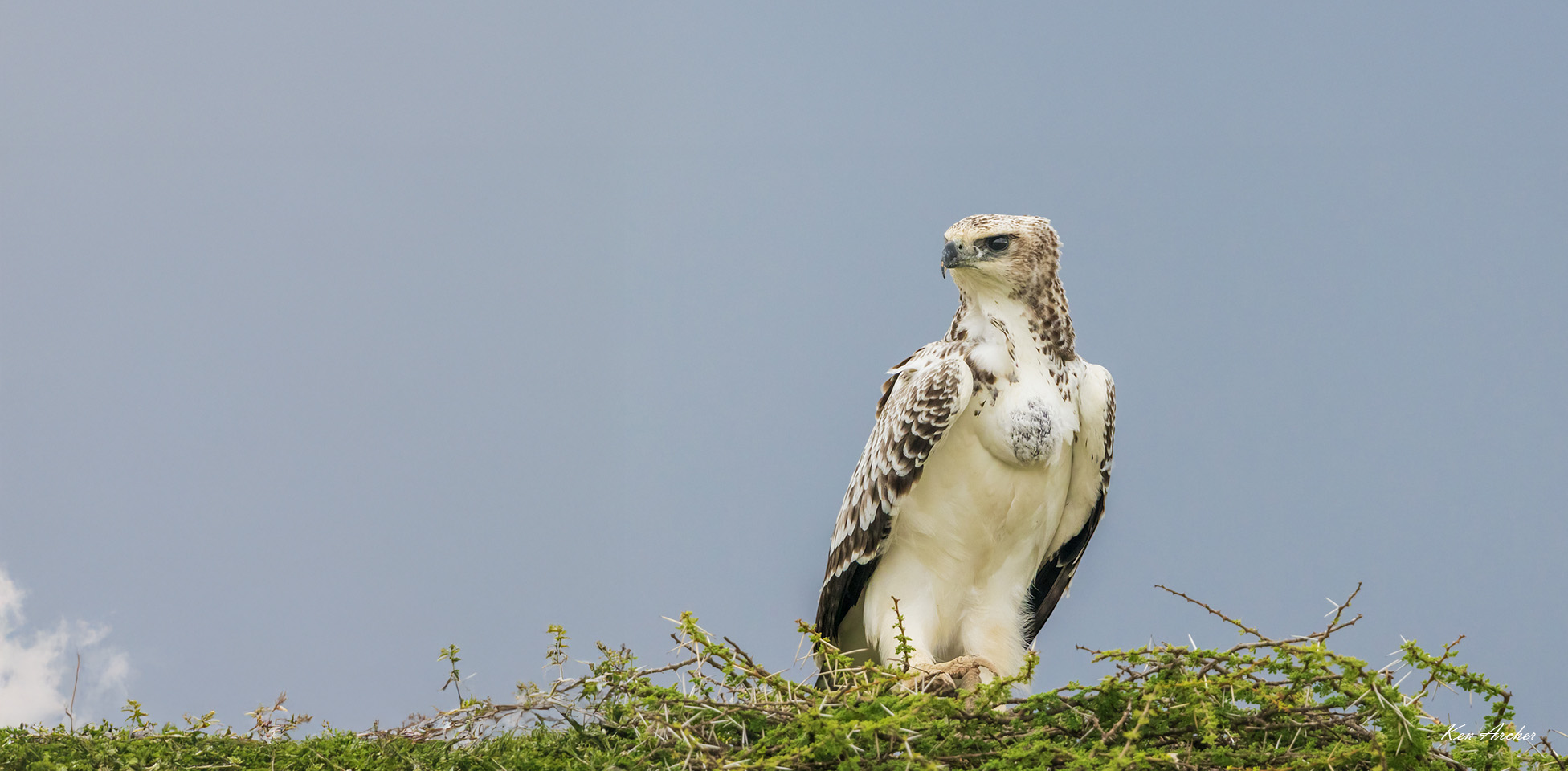
Martial Eagles (Polemaetus bellicosus) are among the largest and most powerful raptors in sub-Saharan Africa. Listed as Endangered on the IUCN Red List, these apex predators soar over vast savannas and open woodlands in search of prey, playing a crucial role in maintaining the balance of their ecosystems. However, their expansive range also exposes them to growing threats—including habitat loss, reduced prey availability, and direct persecution.
By studying their movements, habitat use, and breeding success, BRI aims to uncover the ecological pressures driving their decline and to inform conservation strategies that ensure these iconic eagles continue to thrive in Africa.

Tagged Martial Eagle perched © Stratton Hatfield.
Research methods
Our team uses a combination of field-based and technological approaches to study raptor ecology, including:
- Survey and transect observations to record abundance and distribution
- Point counts to monitor presence and behavior over time
- GPS tagging to track large raptors and map habitat use
In early 2025, BRI and collaborators captured and fitted two adult Martial Eagles with GPS tags to better understand their movement patterns and habitat use. Tracking data will help identify key foraging grounds and nesting territories, providing insights into how these apex predators interact with changing landscapes. Photos © Eurafrica Conservation Projects.


Raptor findings and distribution
Integrating data and observations from point counts and transect surveys from 2023 – 2025, we have detections of over 1000+ individuals from 38 raptor species. The raptor abundance and distribution varies across communities surveyed, but the most numerous species are: Eastern Chanting-Goshawk, Pygmy Falcon, Gabar Goshawk, White-backed Vulture, and Black-winged Kite.
The figure below shows a spatial summary of species distribution and detections from baseline monitoring in Kenya from 2023 – 2025 for (a) opportunistic observations of eagle species and (b) opportunistic observations of vulture species.

Martial Eagle Tracks
The map depicts Martial Eagle tracks from April – August 2025, coinciding with its breeding season in East Africa. During this time, the parental eagle pair is expending significant energy, actively hunting and searching for food for their chick.
Martial Eagles tend to have variable home range sizes, ranging from 15 km² to over 300 km². As Amboseli is nearly 400 km², the breeding movement range of the tagged eagle pair is concentrated within Amboseli and the greater Kenya-Tanzania border.
This data and the environmental observations gathered over time allow us to see how raptor movements change as the ecosystem changes.

Map of Martial Eagle movements from April to August 2025 in Kajiado, Kenya.
Partnerships and Collaboration
In Kenya, BRI collaborates closely with the Kenya Wildlife Service and regional conservation partners to advance raptor research and protect key habitats. Our work in East Africa aligns with international conservation frameworks such as the Verra Climate, Community & Biodiversity Standards (CCBS), which promote projects that benefit both wildlife and local communities.
Other partners in Africa include CarbonSolve, Soils for the Future Africa and Soils for the Future Tanzania.
For more information on our international raptor work, contact Ed Jenkins (edward.jenkins@briwildlife.org) or Chris DeSorbo (chris.desorbo@briwildlife.org).
Photo credits: Header- Martial Eagle, Ken Archer; Amboseli Landscape, Ken Archer, Maps © BRI.

