

On this page: Introduction | The Goal | Our Approach|2024 Findings| Partnerships| Funding Support
 Gulf of Maine Bat Research Program (GoMBat)
BRI leads the GoMBat Research Program, a partnership of fishermen, academic institutions, NGOs, and state and federal agencies using acoustic monitoring to understand bat activity and occurrence in the Gulf of Maine.
Header photo © Madelyn Talpt, taken on Machias Seal Island, NB
The Goal
 We often think of bats circling around our homes at night or roosting in caves and trees, but bats are also known to fly across the open ocean to migrate and forage, and have been documented out in the Gulf of Maine.
We’re interested in learning when and where they occur over the waters of the Gulf, and what they’re doing out there. These data will help inform the risk to bats from offshore activities such as wind energy development.
Our Approach

We use acoustic detectors with ultrasonic microphones to listen for and record the high frequency calls of bats to document species presence. With support from the Maine Department of Inland Fisheries and Wildlife (IFW), BRI deployed acoustic detectors in 2024 on opportunistic vessels, including a bottom-trawling fishing vessel and a seafloor mapping vessel, that traversed different regions of the Gulf of Maine, as well as on islands and at coastal sites around the Gulf.
A continuation of this effort is currently underway in 2025 through support from IFW, UMaine, and the Davis Foundation, with new deployments planned on fishing vessels, a floating offshore wind turbine, and a weather station buoy.
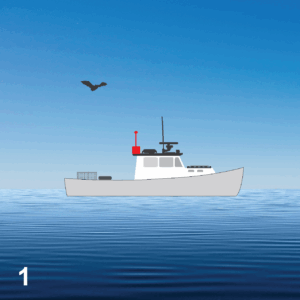
Mobile bat acoustic monitoring is conducted from vessels transiting opportunistically through the Gulf of Maine.
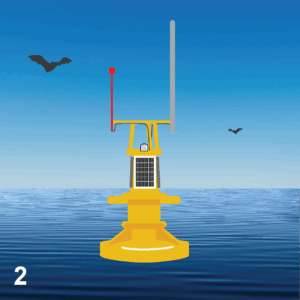
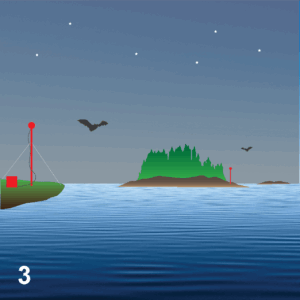
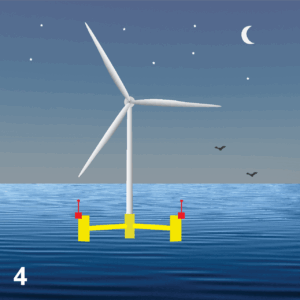
BRI will work with UMaine in 2025 to acoustically monitor bats at the Floating Offshore Wind Turbine, 1:4 VolturnUS, in Penobscot Bay.
2024 Findings
BRI collected bat acoustic data from July through October 2024 for a total of 223 monitoring nights across 3 vessel platforms, five islands, and at two coastal sites. Data from vessels included 119 bat passes, representing a few notable species, including the hoary bat (Lasiurus cinereus) and eastern red bat (Lasiurus borealis), which are known as the migratory tree bats. We also detected the big brown bat (Eptesicus fuscus), a species more commonly associated with urban or forested habitats. The most frequently detected bat out at sea was the eastern red bat, which was also the species found farthest offshore, with one pass recorded 136 km from Cape Cod, MA, and one pass detected within the BOEM-proposed Gulf of Maine offshore wind lease areas. These results were published in Northeastern Naturalist, and can be viewed here.

Island and coastal sites with bat acoustic detectors during fall 2024 monitoring effort.
The 2024 effort highlighted that (1) bats are found offshore in the Gulf of Maine, including during daytime hours, at varying distances from the coastline, and within the proposed offshore wind lease areas, (2) bat activity levels offshore appear lower than at coastal and island sites, and (3) bat activity at a given site is likely influenced by temporal and spatial factors, such as distance to shore, weather patterns, island size, light levels, and local habitat. Findings from this effort will help inform and refine continued Gulf of Maine bat acoustic monitoring in 2025, as well as future monitoring supported by the Maine Governor’s Energy Office.

Results of the bat acoustic monitoring effort from the F/V Maria Jo-Ann. Possible bat follow behavior of the F/V Maria Jo-Ann is displayed in the callout box.
 Further reading:
Opportunistic Vessel-Based Detections in of Migratory Bats in the Gulf of Maine
Bat Acoustic Monitoring in the Gulf of Maine
Outreach Flyer: F/V Titan
Learn more about this effort from our Interactive Map!
Partnerships
This work would not be possible without the support of numerous stakeholders across sectors and industries.
Key Partners

Bat Conservation International
..

Maine Coast Fishermen’s Association
..
Advisors
- Bureau of Ocean Energy Management
- Canadian Wildlife Service
- United States Fish and Wildlife Service
- Wildlife Acoustics
Detector Hosts
- Black Point Corporation & The Sprague Corporation
- College of the Atlantic
- Gilsland Farm Aubudon Center
- Maine Coastal Islands National Wildlife Refuge
- Maine Department of Marine Resources
- National Audubon
- Northeastern Regional Association of Coastal Ocean Observing Systems
- University of New Hampshire/Shoals Marine Lab
- University of Maine
- University of New Brunswick
- Various Vessel Operators and Land Owners
- Spring Point Marina
Fishermen involvement:
We’re looking for additional fishermen and other vessel operators who travel through the Gulf of Maine at night and would be willing to host a bat detector on their vessel. For more information, please reach out to: Wing Goodale at wing.goodale@briwildlife.org or Merra Howe at merra.howe@briwildlife.org

F/V Titan survey effort conducted by Maine Department of Marine Resources was provided by the Maine Offshore Wind Research Consortium
Funding Support
Funding Support: We acknowledge the generous support of the Maine Department of Inland Fisheries and Wildlife, Maine Governor’s Energy Office, University of Maine, Davis Foundation, and Equinor. Their contributions have been instrumental in advancing our research.



Photo Credits: Header photo © Madelyn Talpt, taken on Machias Seal Island, NB; SM4 detector © BRI; F/V Titan © BRI

