Environmental Support for Indigenous People and Local Communities

Working collaboratively with Tribal Nations and Indigenous communities to support environmental assessment, natural resource stewardship, and restoration

Science grounded in collaboration and respect

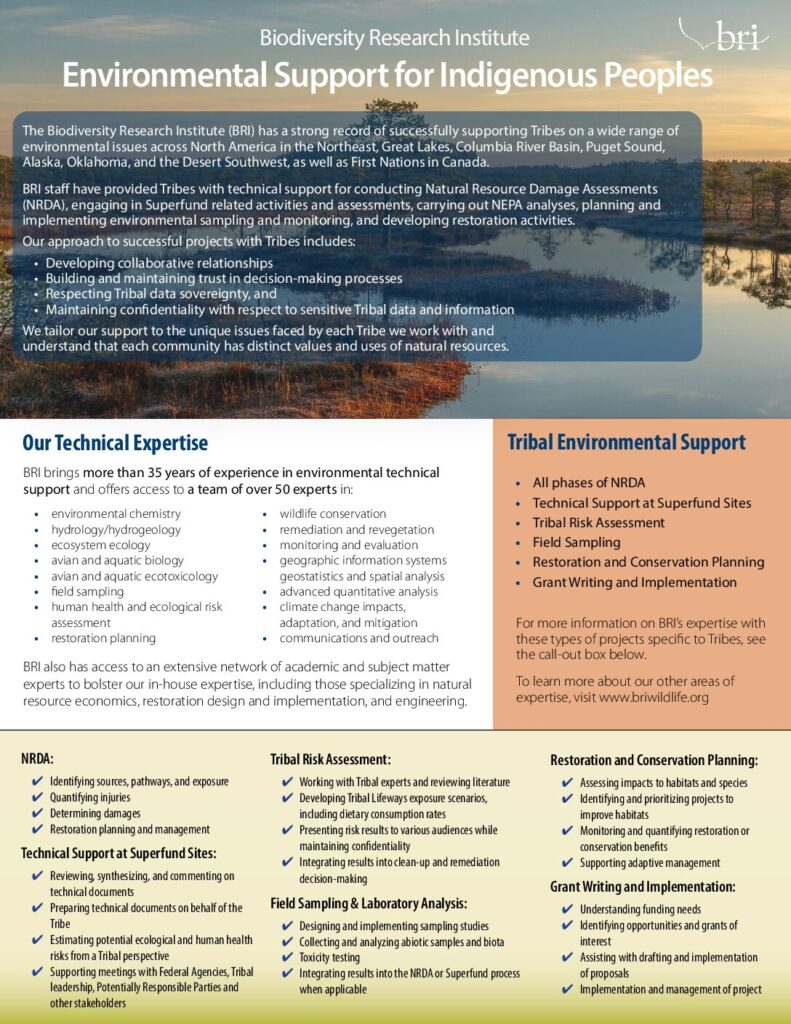
Biodiversity Research Institute (BRI) supports Tribal Nations and First Nations across North America on a wide range of environmental issues. Our work includes natural resource damage assessments, technical support at Superfund sites, environmental sampling and monitoring, risk assessment, and restoration planning.

We tailor each project to the interests, priorities, and natural resource uses of the communities we work with, collaborating with Tribal staff, experts, Elders, and community members.
Environmental services tailored to Tribal priorities

BRI brings scientific expertise and access to specialist collaborators to support environmental decision-making.

  • Natural Resource Damage Assessments (NRDA)
  • Superfund technical support
  • Tribal risk assessment
  • Field sampling and laboratory analysis
  • Restoration and conservation planning
  • Grant writing and implementation

Our approach to partnerships

Our work is guided by collaborative relationships and respect for each community’s distinct priorities and perspectives.

Featured Environmental Support Projects

BRI works directly with Tribal governments and alongside Tribal, state, and federal partners. These examples illustrate a few ways our scientific teams support community priorities.

North American Tribes

Maasai Community

Supporting Small Island
Developing States (SIDS)
Through Multilateral
Environmental Agreements

Featured Projects:

Spokane Tribe of Indians: Assessing contamination and supporting restoration. BRI's NRDA Group have supported work associated with the Midnite Mine and Upper Columbia River, including environmental sampling, contaminant assessment, technical review, and restoration planning.

Seven Tar Creek Tribes: Supporting a Tribal-led apprenticeship program. BRI's NRDA Group helped develop and implement a restoration- and culture-focused apprenticeship initiative for Tribal youth, working with coordinators and local experts to build a program informed by Tribal perspectives.

Passamaquoddy Tribe: Understanding exposure risks in harvested wildlife. In Maine, BRI's NRDA Group is collaborating on analyses of contaminants in fish and mammals harvested for consumption and supporting development of guidance on safe food consumption practices.

Mi'kmaq Nation: Evaluating Mercury and Lead Exposure Risk in Bald Eagles and Common Loons. Mi’kmaq Nation partnered with biologists from BRI to capture and collect samples from both Bald Eagles and Common Loons throughout the Fish River Chain of Lakes region to evaluate the exposure to mercury and lead.

Carbon Project collaboration in Kenya and Tanzania.
In partnership with CarbonSolve, Soils for the Future Africa, and Soils for the Future Tanzania, these projects aim to generate increased local capacity to better manage degraded rangelands, and in the process generate sufficient financial benefits from carbon revenues.

BRI works with international partners to support the implementation of Multilateral Environmental Agreements (MEAs), particularly the Minamata Convention on Mercury. Through scientific research, mercury assessments, and capacity building, BRI helps countries, including Small Island Developing States (SIDS), better understand mercury pollution and its impacts on human health, wildlife, and ecosystems.


A key component of this work is the development of regional mercury monitoring networks, which strengthen local scientific capacity, support collaboration among laboratories, and generate data on mercury exposure in fish, wildlife, and people.